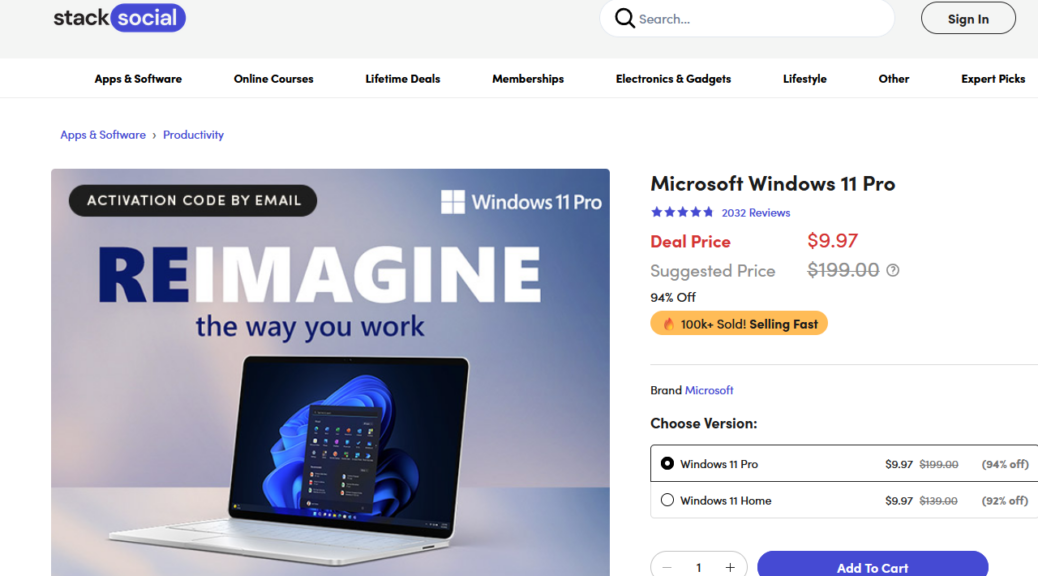
Every so often, a new round of bargain‑basement Windows license deals makes the rounds. You’ve seen them: Windows 11 Pro for ten bucks, Windows 10 Pro for even less. They pop up on StackSocial, StackCommerce, and a handful of deal‑driven tech sites. And like clockwork, the obvious question arises: Is this for real, or too good to be true? Neither and both: indeed, understanding el-cheapo Windows licenses hits both sides of this common wisdom.
More On Understanding El-Cheapo Windows Licenses
As someone who’s been around the Microsoft ecosystem for a long time — and who has more legit keys than I’ll ever need thanks to MVP status — I find the whole phenom fascinating. Not because I need another license, but because these offers sit right at the intersection of Microsoft’s licensing rules, its activation infrastructure, and the gray‑market economy surrounding both.
Here’s the key (pun intended): activation and licensing are not the same. Activation is a technical handshake with Microsoft’s servers. Licensing is a legal framework that governs how a key is properly obtained and used. Those two systems overlap, but they don’t enforce each other as tightly as many expect and assume.
Most $10 keys fall into one of three buckets. The first is unused OEM keys pulled from bulk hardware purchases. Perfectly valid keys, never activated on their original devices, but not transferable under Microsoft’s rules. The second bucket is decommissioned or oversold MAKs (multiple activation keys) — volume license keys with high activation counts that get resold repeately. They activate until the pool runs dry. The third bucket is region‑restricted retail keys, bought cheaply in low‑cost markets and resold elsewhere. They activate just fine, and Microsoft rarely retroactively enforces region boundaries.
None of these keys is counterfeit. They’re simply not authorized for retail distribution and sales. And that’s the crux of the matter. A key can be technically valid and still not legitimate under Microsoft’s licensing terms. That’s why you see disclaimers like “Microsoft may deactivate this license” — something never attached to a true retail key.
Why Not Stop This Madness?
So why doesn’t Microsoft shut this down? Because enforcement is aimed at organizations, not individuals. Say a corporate MAK pool gets audited and is found to be leaking keys. Then, the consequences fall on the organization that holds the license — not the end user who bought a $10 key online. Microsoft’s activation infrastructure is built for compatibility and ease of deployment, not aggressive policing. As long as the upstream license pool stays quiet, the key will likely keep working.
That’s why you see technically savvy users reporting years of trouble‑free activation. They’re not wrong. They’re simply describing the operational reality, not the licensing reality.
In the end, these cheap keys occupy a curious middle ground: not fake, not fully legitimate, but functional and low‑risk for individual buyers. They’re a reminder that Windows licensing is strict on paper, pragmatic in practice, and full of gray areas that only get more interesting the deeper you dig.
Here in Windows-World one perforce gets comfortable with gray areas. This one seems a bit more gray and shadowy than most, but there you have it!

