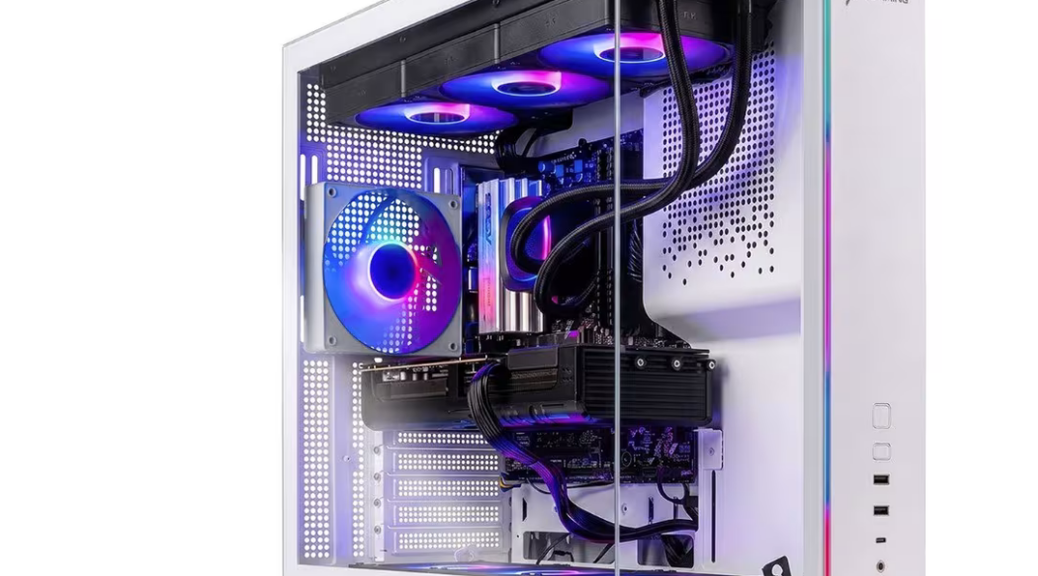
I had a real “How in the heck did they DO that?” moment this morning, reading over recent Tweaktown coverage.In this case (pun intended) PC pricing induces a self-builder (like your humble correspondent) to stop and check the numbers. This $2,430 Skytech gaming desktop at Walmart pairs an AMD Ryzen 7 9800X3D with an NVIDIA GeForce RTX 5070 Ti, 32GB of DDR5-6000, a 2TB NVMe SSD, a 360mm AIO and an 850W Gold power supply. “Hmmm,” I said to myself, “is this exploiting the benefits of inventory timing?”
By way of comparison, I priced a broadly comparable do-it-yourself configuration using recognizable retail components. Those parts came to $2,973.84 before tax. That puts the Walmart machine $543.84 below the DIY total, about 18 percent cheaper. Even removing the $139.99 Windows 11 Home license leaves DIY at $2,833.85. The prebuilt still leads by more than $400. Amazing!
Comparison Shows Possible Benefits of Inventory Timing
Here’s the comparison that caught my eye. The CPU, graphics card and memory alone total $2,013.90 at today’s prices: that leaves only $416.10 between those three retail parts and Walmart’s price for the whole shebang. Here’s a priced-out build list with today’s per-item “best cost” selections.
| DIY PC vs. Walmart Skytech | ||
|---|---|---|
| Component | DIY selection | Price |
| CPU | AMD Ryzen 7 9800X3D | $444.00 |
| GPU | ASUS Prime RTX 5070 Ti 16GB | $1,119.99 |
| Motherboard | ASUS TUF Gaming B850-Plus Wi-Fi | $216.99 |
| Memory | 32GB DDR5-6000 CL30 | $449.91 |
| SSD | Crucial E100 2TB Gen4 NVMe | $249.99 |
| CPU cooler | Arctic Liquid Freezer III Pro 360 A-RGB | $129.99 |
| Case | Lian Li Lancool 207 | $82.99 |
| Power supply | Corsair RM850x 850W Gold ATX 3.1 | $139.99 |
| Operating system | Windows 11 Home | $139.99 |
| DIY TOTAL | $2,973.84 | |
| Walmart Skytech | $2,430.00 | |
| PREBUILT ADVANTAGE | $543.84 | |
Why Say: Inventory Timing May Be at Work?
My best explanation for this sizable gap is inventory timing. Skytech may be building these systems from CPUs, memory, graphics cards and other components they acquired earlier. I assume that means at significantly lower costs than today’s per-item retail prices. Bulk purchasing could widen that gap.
That’s a premise rather than something documented. I don’t know Skytech’s acquisition cost or when its inventory was purchased. But the retail comparison makes this idea plausible. A system builder does not necessarily face the same replacement cost that confronts somebody ordering nine separate parts today.
That distinction matters especially around the holidays. A manufacturer with favorable inventory costs can turn older purchasing decisions into a current sales weapon. Instead of simply protecting margin, the vendor can pass some of the advantage along and produce a price that DIY buyers have difficulty matching.
Does DIY Even Compete/Compute Here?
The case for building your own PC isn’t entirely nixed. A self-build lets one choose the exact motherboard, SSD, power supply, cooler and graphics card. With the Skytech system, several of those specific makes and models are unspecified or may vary (and may not be to your liking). Component control has real value, particularly for buyers who care about firmware, expansion, acoustics or long-term serviceability.
A Deal Worth Considering
Still, $544 buys lots of component preference. At $2,430, I would have trouble justifying an equivalent self-build strictly on price. The Walmart system arrives assembled, includes Windows and carries a system warranty.
That makes this a useful lesson in PC purchasing. Current retail component prices don’t always dictate price for a prebuilt PC. Inventory has history. When a manufacturer bought well, and decides to turn that advantage into aggressive holiday pricing, yesterday’s inventory can become today’s bargain.
I’ve got to admit this is a good enough deal that I’m actually thinking it over. But with at least 4 strong, decently-equipped PCs here at Chez Tittel, I’ll probably have trouble selling to “The Boss.” But here in Windows-World, I can always dream about my next PC, knowing it’s a matter of “when,” not “if.”

